

Hosanna Meaning: The Complete Guide to This Ancient Cry of Praise
Hosanna meaning is one of those things many people hear in church but never fully understand. You’ve sung it in songs. You’ve heard it in sermons. But what does it actually mean? Where does it come from? And why does it still matter today?
Here’s the truth: most people get it partially right. They think “hosanna” simply means praise. But the real meaning is deeper — and more surprising — than that.
In this guide, you’ll discover the full hosanna meaning in Hebrew, Greek, and Aramaic. You’ll learn how it was used in the Bible, why it mattered on Palm Sunday, and how its meaning shifted over centuries. By the end, you’ll understand this ancient word like never before.
What Is the Hosanna Meaning? The Definition That Surprises Most People
The word “hosanna” doesn’t mean praise. Not originally.
The hosanna meaning comes from the Hebrew phrase hoshi’a na, which translates as “save us, we pray” or “save now.” It’s a cry for help — not a shout of celebration.
Think about that. Every time a choir sings “hosanna,” they’re echoing an ancient plea for rescue.
Hosanna Meaning in Hebrew
In Hebrew, hoshi’a comes from the root yasha, meaning “to save” or “to deliver.” The word na is an urgent particle that adds intensity. Together, hoshi’a na = “save, please!”
This is important. The hosanna meaning in Hebrew is rooted in desperation, not joy. It’s the language of someone who needs help — now.
Hosanna Meaning in the Bible — Old Testament Roots
The phrase appears directly in Psalm 118:25: “Save us, we pray, O Lord!” This psalm was part of the Hallel — a group of psalms sung during Jewish festivals like Passover.
Jewish crowds knew this psalm by heart. When they cried “hosanna,” they weren’t just cheering. They were quoting Scripture and begging God to act.
Hosanna Meaning in Greek and Aramaic — How It Crossed Languages
Languages change words. “Hosanna” is a perfect example.
Hosanna Meaning in Greek
When the Hebrew scriptures were translated into Greek (the Septuagint), hoshi’a na was transliterated — kept as a sound, not translated as a meaning. So Greek-speaking readers heard “hosanna” without knowing it originally meant “save us.”
This is why the hosanna meaning in Greek is technically a borrowed sound, not a native word. The Greek New Testament preserves it as hōsanna — a transliteration, not a translation.
Hosanna Meaning in Aramaic
By Jesus’ time, most Jews in Judea spoke Aramaic. The Aramaic form of the cry was very similar to the Hebrew. It still carried the root meaning of salvation and deliverance. The hosanna meaning in Aramaic essentially matches the Hebrew — a heartfelt plea to be saved.
What’s fascinating is how this word traveled. Hebrew → Aramaic → Greek → Latin → English. And at each step, it kept its sound but gradually lost its literal meaning.
Palm Sunday Hosanna Meaning — The Most Famous Use in the Bible
This is where it all clicks together.
Palm Sunday hosanna meaning is central to understanding Holy Week. When Jesus entered Jerusalem on a donkey, crowds lined the road. They waved palm branches. And they shouted hosanna.
Here’s the full verse from Matthew 21:9: “Hosanna to the Son of David! Blessed is he who comes in the name of the Lord! Hosanna in the highest!”
Why They Shouted Hosanna on Palm Sunday
The crowd had two things in mind:
- Praise — They saw Jesus as the promised Messiah.
- Petition — They were begging him to save them from Roman oppression.
So the hosanna meaning on Palm Sunday was both worship and a desperate request. The people wanted a deliverer. A king. Someone to set them free.
Jesus accepted this greeting. But his idea of salvation was far bigger than political freedom.
Hosanna in the Highest — What Does It Mean?
“Hosanna in the highest” means the cry goes all the way to heaven. It’s asking God above — in the highest place — to send salvation. It’s an amplified version of the same plea: Save us, God, from your throne in heaven.
| Phrase | Meaning |
|---|---|
| Hosanna | Save us, we pray |
| Hosanna to the Son of David | Save us through the Messiah |
| Hosanna in the highest | May heaven respond to our cry |
Hosanna Meaning Biblical Definition — How It Shifted from Plea to Praise
Here’s something remarkable. A word that started as a cry for help became a shout of celebration.
How did that happen?
Think about it this way. If someone shouts “Help me!” in a moment of fear, and then they’re actually rescued — that same cry becomes a victory shout. That’s exactly what happened with “hosanna.”
Early Christians believed Jesus was the answer to the plea. He saved humanity through his death and resurrection. So shouting “hosanna” stopped being a request and became a declaration: “He has saved us!”
Hosanna Meaning KJV — What the King James Version Shows
In the King James Version, “hosanna” appears in Matthew 21:9, Mark 11:9-10, and John 12:13. The KJV keeps the original transliteration — “Hosanna” — without translating it. This preserves the sound but doesn’t explain the depth of the original plea.
The hosanna meaning KJV context makes clear it was a messianic greeting. The crowds were welcoming a king, not just singing a happy song.
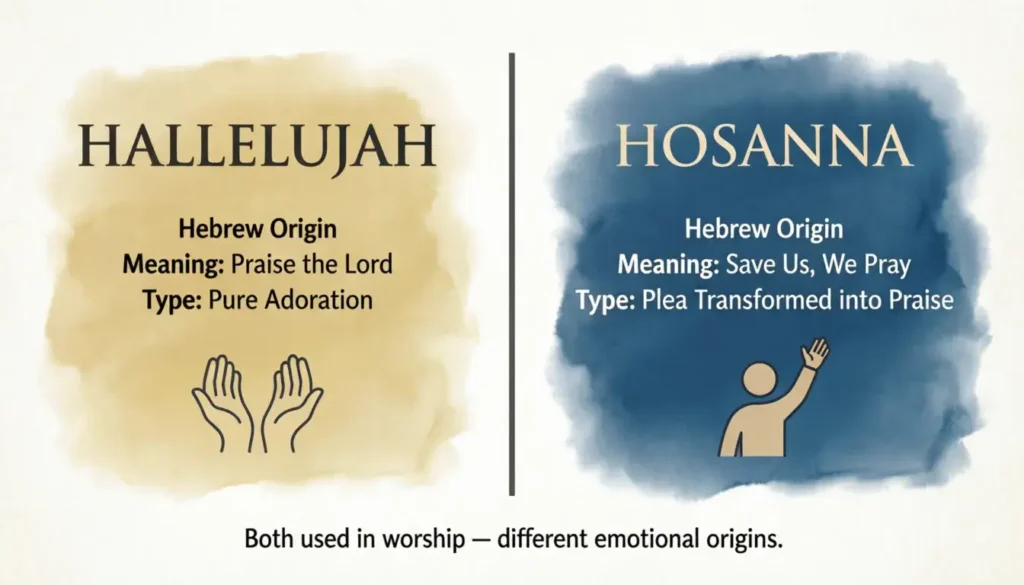
Hallelujah Hosanna Meaning — Are They the Same?
People often use “hallelujah” and “hosanna” interchangeably. They’re not the same.
| Word | Language | Literal Meaning | Type |
|---|---|---|---|
| Hallelujah | Hebrew | Praise the Lord | Pure praise |
| Hosanna | Hebrew | Save us, we pray | Plea + praise |
Hallelujah is entirely a praise word. It means “praise Yahweh.” There’s no request in it. Just worship.
Hosanna, as we’ve seen, started as a petition. It evolved into praise over time. But even in its praise form, it carries undertones of salvation and rescue.
So the hallelujah hosanna meaning comparison shows us two different postures: one is celebratory adoration, the other is grateful deliverance.
Just like understanding slang words requires context — such as knowing what does NP mean or what does OFC mean in modern usage — ancient words like hosanna carry layers of meaning that shift depending on context.
Hosanna Meaning in English — How We Use It Today
In modern English, “hosanna” functions as an exclamation of praise or joy. Most English speakers associate it with religious contexts — especially Christian worship and Palm Sunday celebrations.
The hosanna meaning in English today is essentially: “Praise God!” or “Glory to God!”
But now you know the backstory. That praise is tied to salvation. Every “hosanna” contains an echo of the original cry: Save us.
Hosanna Meaning for Kids — A Simple Explanation
If you’re explaining this to children, try this:
- Hosanna means “please save us” in the original language.
- When Jesus rode into Jerusalem, the people shouted it.
- They were saying: “You are the one who saves us!”
- Over time, it became a word of praise and celebration.
A good analogy: imagine cheering for a firefighter who just rescued someone from a burning house. The cheer started from fear and need — but it became a shout of gratitude and joy.
Hosanna Meaning Origin — The Historical Journey of a Word
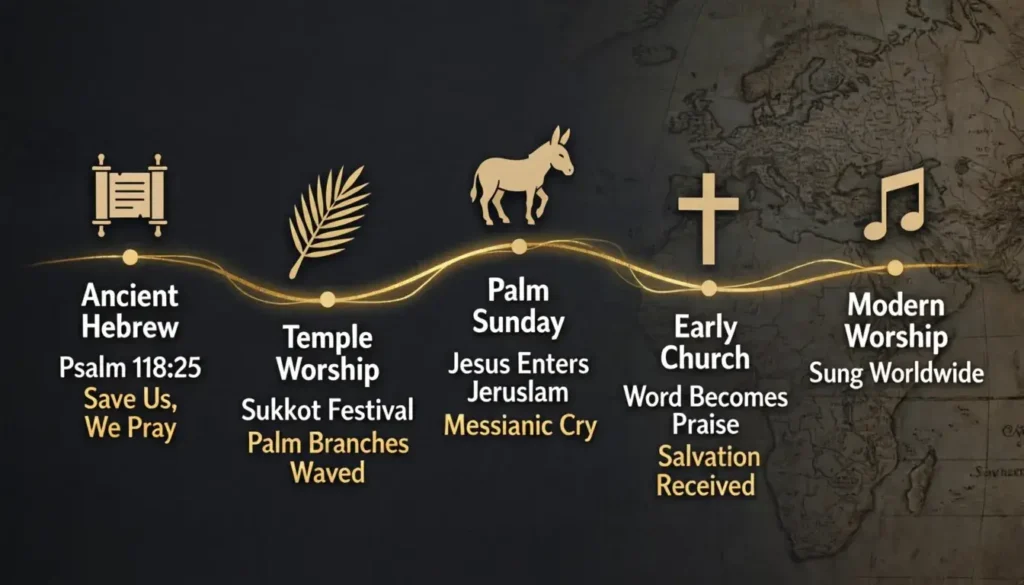
The hosanna meaning origin traces back thousands of years. Here’s a quick timeline:
1. Ancient Hebrew — Hoshi’a na used in Psalms as a liturgical cry for God’s rescue.
2. Temple Worship — Priests and worshippers shouted it during Sukkot (Feast of Tabernacles) while waving palm branches — the same tradition echoed on Palm Sunday.
3. Jesus’ Entry — The crowd used it as a messianic greeting, blending celebration with desperate hope.
4. Early Church — Christians adopted it as a word of praise, confident that Jesus had fulfilled the salvation the word requested.
5. Modern Worship — Churches worldwide still sing it, often without knowing its original meaning.
Understanding this journey enriches every worship experience. Words carry history. Hosanna carries centuries of hope.
Hosanna Meaning LDS — How Latter-day Saints Use This Word
In the LDS (Latter-day Saint) tradition, “hosanna” holds special significance. The hosanna meaning LDS context involves what’s called the Hosanna Shout.
This is a sacred ritual performed at temple dedications. Participants wave white handkerchiefs and shout “Hosanna! Hosanna! Hosanna!” three times, followed by “to God and the Lamb.”
It echoes the Palm Sunday scene and the ancient temple worship. It’s a collective cry of praise and gratitude — recognizing Christ as Savior.
The LDS use of hosanna reflects the word’s dual nature: it’s both a plea and a praise, a recognition that salvation has come through Jesus Christ.
Hosanna Meaning in Hindi — The Word Across Cultures
Christianity spread worldwide, and “hosanna” traveled with it. In Hindi-speaking Christian communities in India, the word is used in worship songs and liturgical settings.
The hosanna meaning in Hindi is rendered as होसन्ना (Hosanna), keeping its original sound. Indian Christians understand it as a cry of praise to God — similar to how it’s used globally.
This cross-cultural presence shows how a single ancient Hebrew word became part of worship in dozens of languages. It’s a reminder that certain truths — like the need for salvation — cross every cultural boundary.
Much like modern slang crosses digital borders (think what does rizz mean or what does WTW mean spreading globally through social media), ancient words like hosanna have their own viral trajectory through history.
Comparison Table: Hosanna Across Different Contexts
| Context | Primary Meaning | Usage |
|---|---|---|
| Hebrew Bible | Save us, we pray | Liturgical petition |
| Palm Sunday | Messianic welcome + plea | Crowd acclamation |
| Early Church | Praise for salvation received | Worship expression |
| Modern Christianity | Praise to God | Hymns and liturgy |
| LDS Tradition | Sacred acclamation | Temple dedications |
| Modern English | Exclamation of praise | Religious contexts |
Frequently Asked Questions
What is the hosanna meaning in simple terms?
Hosanna originally meant “save us, please” in Hebrew. It was a cry for God’s rescue. Over time, especially after Jesus’ entry into Jerusalem, it became a word of praise — celebrating the salvation that came through Christ. Today, it’s used as a joyful exclamation of worship in Christian traditions worldwide.
What is the hosanna meaning in the Bible?
In the Bible, hosanna appears most prominently on Palm Sunday (Matthew 21:9). The crowds shouted it to welcome Jesus as the Messiah. Its roots go back to Psalm 118:25, where it’s a direct appeal to God: “Save us, we pray.” The hosanna meaning in the Bible blends urgency, faith, and messianic hope into one powerful word.
Is hosanna the same as hallelujah?
No. Hallelujah means “praise the Lord” — it’s pure adoration. Hosanna means “save us” and evolved into praise. The hallelujah hosanna meaning comparison shows they come from different emotional places: one is celebration, the other is grateful rescue. Both are used in worship, but they carry different original intentions.
What does hosanna mean for kids?
For children, the best explanation is this: hosanna means “please save us!” When Jesus came to Jerusalem, the people were excited because they believed he was God’s chosen king who would rescue them. They shouted hosanna the same way you’d cheer for a hero. It became a way of saying: “You are our Savior — we praise you!”
What is the hosanna meaning in Hebrew specifically?
The hosanna meaning in Hebrew comes from hoshi’a na — two words meaning “deliver” and “please.” The root word yasha means salvation or deliverance. It’s the same root behind the name Yeshua (Jesus). So when people shouted “hosanna” to Jesus, they were — unknowingly or knowingly — calling on the one whose very name means salvation.
What is the Palm Sunday hosanna meaning?
On Palm Sunday, the crowd’s hosanna carried political and spiritual weight. They wanted Jesus to rescue them from Roman rule. They also recognized him as the fulfillment of messianic prophecy. The Palm Sunday hosanna meaning is therefore layered: it’s a welcome, a plea, a confession of faith, and a proclamation that God’s rescue had arrived.
Conclusion: Why Hosanna Meaning Still Matters
Understanding the hosanna meaning changes how you worship.
It’s not just a cheerful church word. It’s an ancient cry — born from desperate need and answered by divine salvation. Every time you sing it, you’re joining millions of voices across centuries who cried out for rescue and found it.
Here are the key takeaways:
- Hosanna originally meant “save us, we pray” in Hebrew.
- It appears most powerfully in the Palm Sunday narrative.
- It evolved from a plea into an expression of praise.
- It connects across cultures — Hebrew, Greek, Aramaic, and beyond.
- Its root is the same as the name Jesus (Yeshua), meaning salvation.
Next time you hear “hosanna” in a song or a sermon, pause for a second. Remember where it came from. Feel the weight of that ancient cry. And let it remind you that praise and need are never far apart.
Want to explore more words with surprising depth? Check out what does KMS mean, what does JFC mean, what does SMD mean, what does FYM mean, and what does GMFU mean — because understanding language, ancient or modern, always starts with asking what words really mean.