Mashallah Meaning: Understanding This Powerful Arabic Expression
Mashallah meaning puzzles many people who hear it for the first time.
You’ve probably heard Muslims say this beautiful word.
But what does it really mean?
The confusion is real.
Many non-Arabic speakers struggle to grasp its true depth.
They see it used in different contexts.
Sometimes it’s about babies.
Other times about achievements.
The pattern seems unclear at first.
Here’s the good news.
This powerful Arabic expression carries a simple yet profound message.
It’s about gratitude, protection, and admiration all rolled into one.
Understanding mashallah meaning in English opens doors to Islamic culture.
In this guide, you’ll discover everything about this expression.
You’ll learn when to use it.
Also you’ll understand its religious significance.
You’ll even discover how it differs from similar phrases.
Plus, you’ll see real examples from everyday conversations.
What Does Mashallah Mean in English?
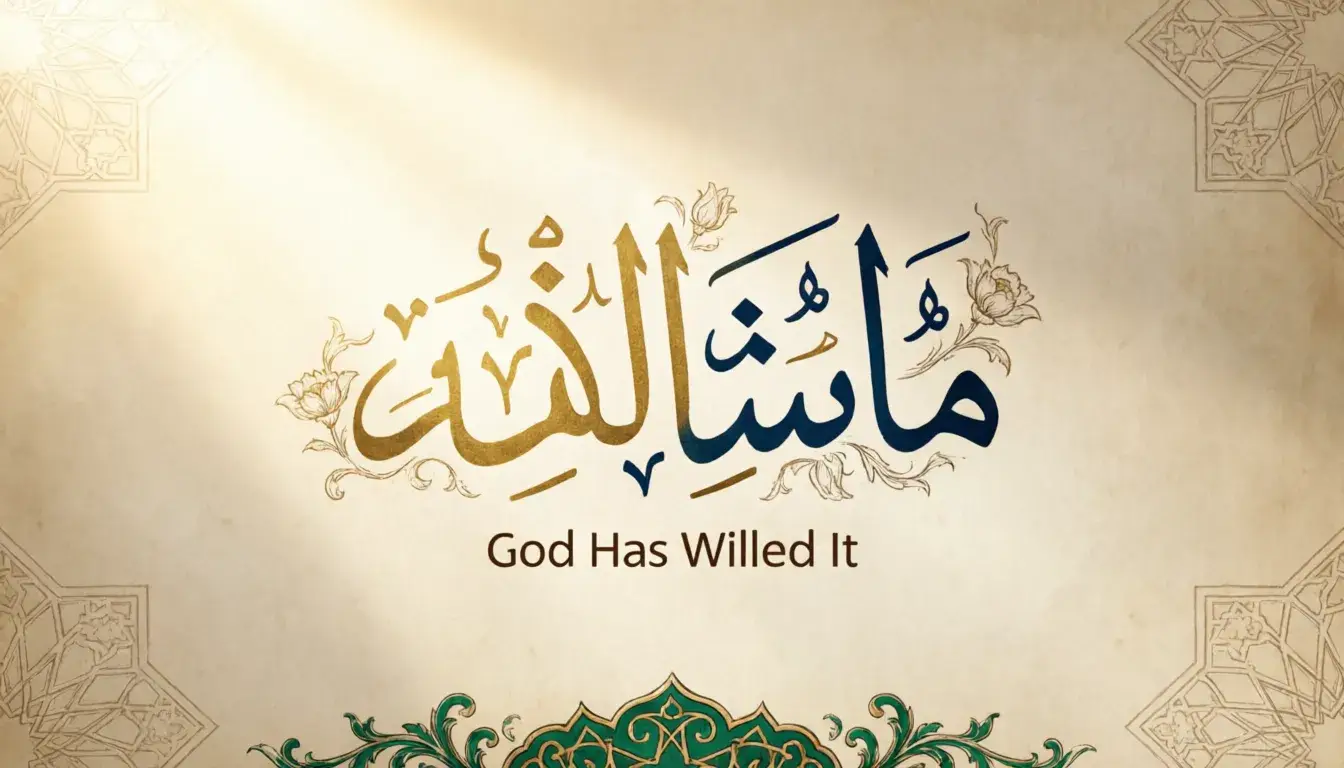
Mashallah meaning in English translates to ‘God has willed it’ or ‘what God wants.’
It’s a recognition of divine will.
Muslims use this phrase to express appreciation.
The word combines two Arabic terms.
‘Ma’ means ‘what’ in Arabic.
‘Sha’ derives from the verb ‘to will’ or ‘to want.’
‘Allah’ is the Arabic word for God.
Together, they create a powerful acknowledgment.
The Literal Translation
Mashallah meaning in Arabic literally means ‘that which God willed.’
It’s not just a simple translation.
The phrase carries deep spiritual weight.
Think of it as praise combined with gratitude.
When someone says mashallah, they’re acknowledging God’s role.
They’re saying everything good comes from divine blessing.
Nothing happens without God’s permission.
Deeper Spiritual Significance
Mashallah meaning in Islam goes beyond simple appreciation.
It’s a protective prayer.
Muslims believe it wards off the evil eye.
The evil eye is envy’s harmful effects.
When you admire something without acknowledging God, problems might follow.
Saying mashallah prevents this spiritual harm.
It keeps blessings safe from jealousy.
When Do Muslims Say Mashallah?
Muslim mashallah meaning becomes clear through its usage patterns.
People say it in many situations.
Each context shares one common thread.
It’s always about acknowledging something good.
Whether big or small, mashallah fits perfectly.
The expression shows humility and faith combined.
Expressing Admiration
You see a beautiful baby.
Say mashallah.
Your friend just bought a new car.
Say mashallah.
Someone achieved a major goal.
Say mashallah.
Mashallah meaning to a girl shows pure appreciation.
It’s never about lust or inappropriate attraction.
It’s respectful acknowledgment of beauty or success.
Similar expressions exist in other languages, like understanding slang terms across different cultures.
Celebrating Achievements
Did your child get straight A’s?
Mashallah!
Did your business land a huge client?
Mashallah!
The phrase celebrates success humbly.
It reminds everyone that achievements come from God.
Hard work matters.
But divine blessing enables true success.
Protecting From Evil Eye
This use is crucial in Islamic tradition.
When you admire something someone owns, say mashallah.
When you compliment someone’s family, say mashallah.
It’s like a spiritual shield.
Your words of praise come with God’s protection.
The blessing remains safe from envy’s harm.
Mashallah vs Other Islamic Expressions
Arabic has many beautiful expressions.
Each serves a different purpose.
Understanding the differences helps you use them correctly.
| Expression | Meaning | When to Use |
| Mashallah | God has willed it | Present achievements, blessings |
| Inshallah | If God wills | Future plans, hopes |
| Bismillah | In the name of God | Before starting actions |
| Alhamdulillah | Praise be to God | Expressing gratitude |
Inshallah vs Mashallah
Mashallah meaning vs inshallah shows a crucial time difference.
Inshallah refers to the future.
Mashallah refers to the present or past.
‘I’ll see you tomorrow, inshallah’ means God willing.
‘Your baby is beautiful, mashallah’ acknowledges God’s blessing.
Inshallah and mashallah meaning complement each other perfectly.
One looks forward with hope.
The other looks at now with gratitude.
Both submit everything to God’s will.
Just like other expressions serve specific purposes in communication.
Bismillah Mashallah Meaning
Bismillah mashallah meaning combines two powerful phrases.
People sometimes say them together.
But they serve different functions.
Bismillah means ‘in the name of God.’
You say it before starting something.
Before eating, say bismillah.
Before driving, say bismillah.
Together, bismillah and mashallah create complete faith.
You start with God’s name.
You acknowledge God’s will in the outcome.
How to Use Mashallah in Different Languages
The expression travels across cultures.
Muslims worldwide use it regardless of their native language.
But pronunciation and context vary slightly.
Mashallah in Spanish
Mashallah meaning in Spanish stays the same as Arabic.
Spanish-speaking Muslims use the Arabic word directly.
There’s no Spanish translation.
Many Islamic phrases work this way.
They remain in Arabic across languages.
This preserves their spiritual meaning.
Similar to how slang terms maintain meaning across different contexts.
Mashallah in Urdu and Hindi
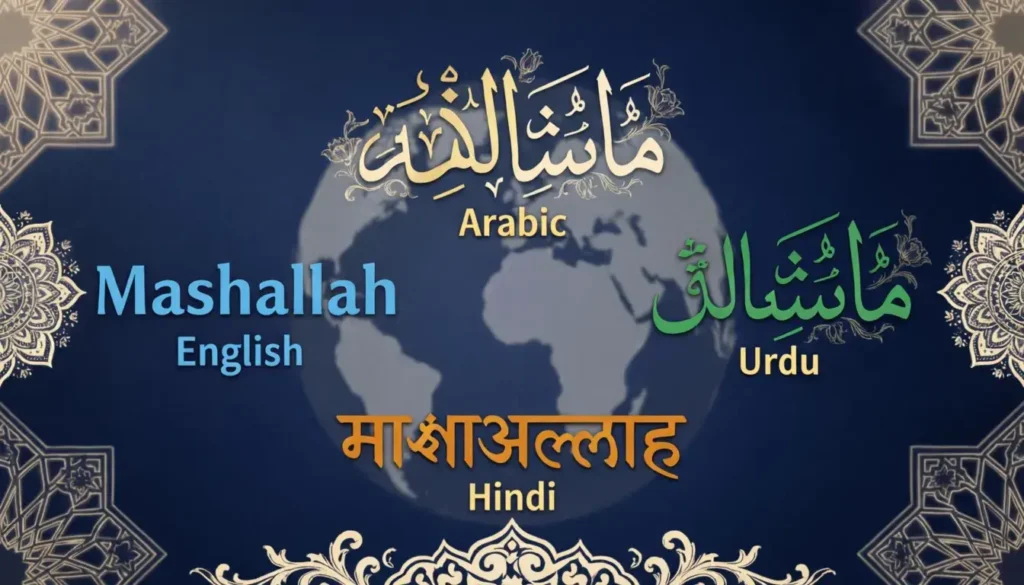
Mashallah meaning in Urdu and Hindi is identical.
These languages borrowed many Arabic words.
Islamic influence shaped their vocabulary.
Mashallah meaning in Hindi appears in everyday conversations.
Even non-Muslims in India and Pakistan use it.
It’s become part of cultural expression.
The pronunciation stays similar to Arabic.
Mashallah meaning in Urdu and English both carry the same spiritual weight.
Urdu speakers might explain it as ‘Allah ki marzi.’
This means ‘God’s will’ in Urdu.
Common Misconceptions About Mashallah
Many people misunderstand this expression.
Let’s clear up the confusion.
Understanding the truth helps you use it properly.
It’s Not Just Polite Small Talk
Mashallah mashallah meaning goes deeper than courtesy.
Some think it’s like saying ‘nice’ or ‘cool.’
That’s not accurate.
It’s a spiritual acknowledgment.
Every utterance carries religious meaning.
Muslims don’t use it casually.
They say it with genuine faith.
You Can’t Use It For Bad Things
Mashallah only applies to blessings.
You don’t say it about negative events.
Someone got sick?
Don’t say mashallah.
A business failed?
Mashallah doesn’t fit.
The expression celebrates good things only.
It’s always about positive acknowledgment.
Understanding context matters, like knowing when to use certain expressions appropriately.
Non-Muslims Can Say It Too
Arabic mashallah meaning isn’t exclusive to Muslims.
Anyone can say it respectfully.
Non-Muslims show cultural appreciation when they use it.
Just understand what you’re saying.
You’re acknowledging the divine.
You’re showing respect for Islamic culture.
Most Muslims appreciate sincere usage.
Practical Examples of Mashallah Usage
Real-life examples make understanding easier.
Let’s look at common scenarios.
These show exactly when to use mashallah.
| Situation | How to Use Mashallah |
| Seeing a friend’s new house | “Mashallah! Your home is beautiful.” |
| Child gets a scholarship | “Mashallah! What an achievement!” |
| Someone lost weight | “Mashallah! You look great!” |
| Baby takes first steps | “Mashallah! Such a big moment!” |
| Business succeeds | “Mashallah! Your hard work paid off!” |
At Family Gatherings
Mashallah meaning islam shines brightest at family events.
Weddings, births, graduations.
You’ll hear mashallah constantly.
Aunties compliment the bride.
“Mashallah, you look stunning!”
Uncles praise the graduate.
“Mashallah, we’re so proud!”
The phrase creates a protective atmosphere.
Every compliment comes with God’s blessing.
Joy stays safe from envious thoughts.
In Professional Settings
Mashallah meaning arabic phrase works in business too.
Muslim professionals use it naturally.
It maintains humility in success.
Your colleague got promoted?
“Mashallah, well deserved!”
The company landed a big contract?
“Mashallah, great teamwork!”
It acknowledges achievement without pride.
Success comes from effort plus God’s blessing.
Similar to understanding professional communication in different contexts.
On Social Media
Mashallah meaning arabic expression dominates Muslim social media.
Comments sections overflow with it.
People type it under every good photo.
New baby pictures?
100+ mashallah comments.
Vacation photos?
Mashallah everywhere.
Some people overuse it online.
But the intention remains pure.
They’re protecting friends from envy.
They’re acknowledging God’s blessings digitally.
Cultural Impact of Mashallah
Arabic mashallah meaning transcends religious boundaries.
The expression shaped entire cultures.
It influences how people think about success.
In Middle Eastern Culture
Middle Eastern families can’t imagine life without mashallah.
It’s more than religious practice.
It’s cultural identity.
Grandmothers say it dozens of times daily.
They mashallah their grandchildren constantly.
It becomes second nature.
Like breathing.
The evil eye belief runs deep.
Mashallah provides essential protection.
Families hang evil eye charms for extra safety.
But mashallah remains the primary defense.
In Western Muslim Communities
Western Muslims maintain this tradition.
They blend it with English conversations.
Code-switching happens naturally.
“That’s amazing, mashallah!”
“Congratulations, mashallah!”
The Arabic word slots perfectly into English.
Second-generation Muslims especially do this.
They preserve their heritage through language.
Mashallah connects them to their roots.
Just as modern expressions evolve in different communities.
Influence on Art and Media
Mashallah meaning arabic appears in modern media.
Songs include it.
Movies use it.
TV shows feature it naturally.
Artists wear jewelry with the word.
Home decor features mashallah calligraphy.
The expression becomes visual art.
Western media slowly recognizes it.
Characters in shows say mashallah.
This spreads understanding.
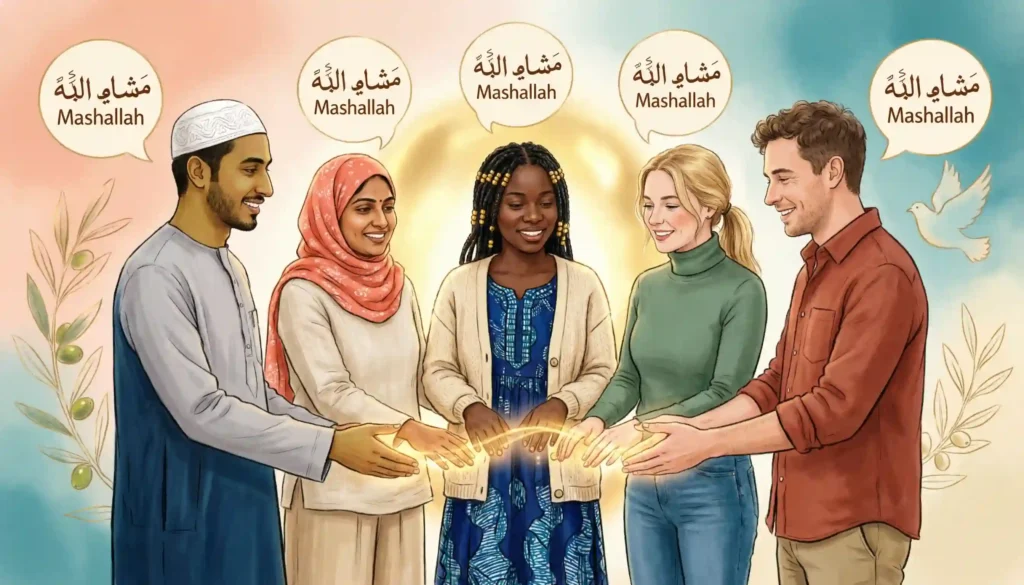
Cultural bridges form through simple words.
Frequently Asked Questions
What is the exact mashallah meaning in English?
Mashallah means ‘God has willed it’ or ‘what God wants.’ Muslims say it when admiring something good to acknowledge God’s role. It combines gratitude, admiration, and protection against envy. The phrase shows that all blessings come from divine will, not just human effort.
Can non-Muslims say mashallah?
Yes, anyone can say mashallah respectfully. You don’t need to be Muslim. Just understand you’re acknowledging the divine when you use it. Most Muslims appreciate when others use it correctly. It shows cultural respect and understanding. Just avoid using it sarcastically or for negative things.
What’s the difference between inshallah and mashallah meaning?
Inshallah refers to future plans (God willing). Mashallah refers to present or past blessings (God has willed). Use inshallah when talking about what might happen. Use mashallah when acknowledging what already exists. One looks forward with hope. The other looks at now with gratitude.
Why do Muslims say mashallah when complimenting someone?
Muslims believe mashallah protects against the evil eye. When you admire something without acknowledging God, your envy might cause harm. Saying mashallah shows your admiration comes with God’s blessing. It keeps the blessing safe. Similar to how understanding cultural expressions helps communication, mashallah adds spiritual protection to compliments.
Is there a difference between mashallah meaning to a girl versus a boy?
No, mashallah meaning stays the same regardless of gender. You use it to acknowledge God’s blessing on anyone. Whether complimenting a girl, boy, man, or woman, the spiritual significance doesn’t change. It’s always respectful admiration with divine acknowledgment. The context and relationship matter more than gender.
How do you pronounce mashallah correctly?
Pronounce it as ‘mah-shah-Allah’ with three syllables. The ‘mah’ sounds like ‘ma’ in mama. The ‘shah’ rhymes with ‘baa’ (like a sheep). Allah has a soft ‘L’ sound. Some regional variations exist, but this pronunciation works universally. Just like learning other expressions, practice makes perfect.
Conclusion
Mashallah meaning goes far beyond simple translation.
This beautiful expression captures faith, gratitude, and protection.
It’s not just words.
It’s a worldview.
Remember these key points.
Mashallah acknowledges God’s will in good things.
It protects blessings from envy.
It works for present and past events only.
Anyone can use it respectfully.
It’s deeply rooted in Islamic culture.
The problem you started with?
Solved.
You now understand this powerful Arabic expression.
Also You know when to use it.
You grasp its spiritual significance.
Here’s your next step.
Start using mashallah in appropriate situations.
Practice with Muslim friends.
Watch how others use it.
Let the expression become natural.
Understanding brings people together.
Language builds bridges between cultures.
Mashallah does both beautifully.
Now go share your knowledge with others.
For more insights on expressions and communication, explore related topics to deepen your cultural understanding.