What Does Congruent Mean? A Complete Guide for Students and Learners
What does congruent mean is one of those questions that trips up students everywhere. You’ve seen the word in math class. You’ve heard your teacher use it. But the exact meaning still feels fuzzy. That’s frustrating — especially when it shows up on tests. Good news: this guide breaks it down simply. By the end, you’ll understand congruent shapes, angles, triangles, and more. No confusion. No jargon. Just clear, practical explanations.
What Does Congruent Mean? The Simple Definition
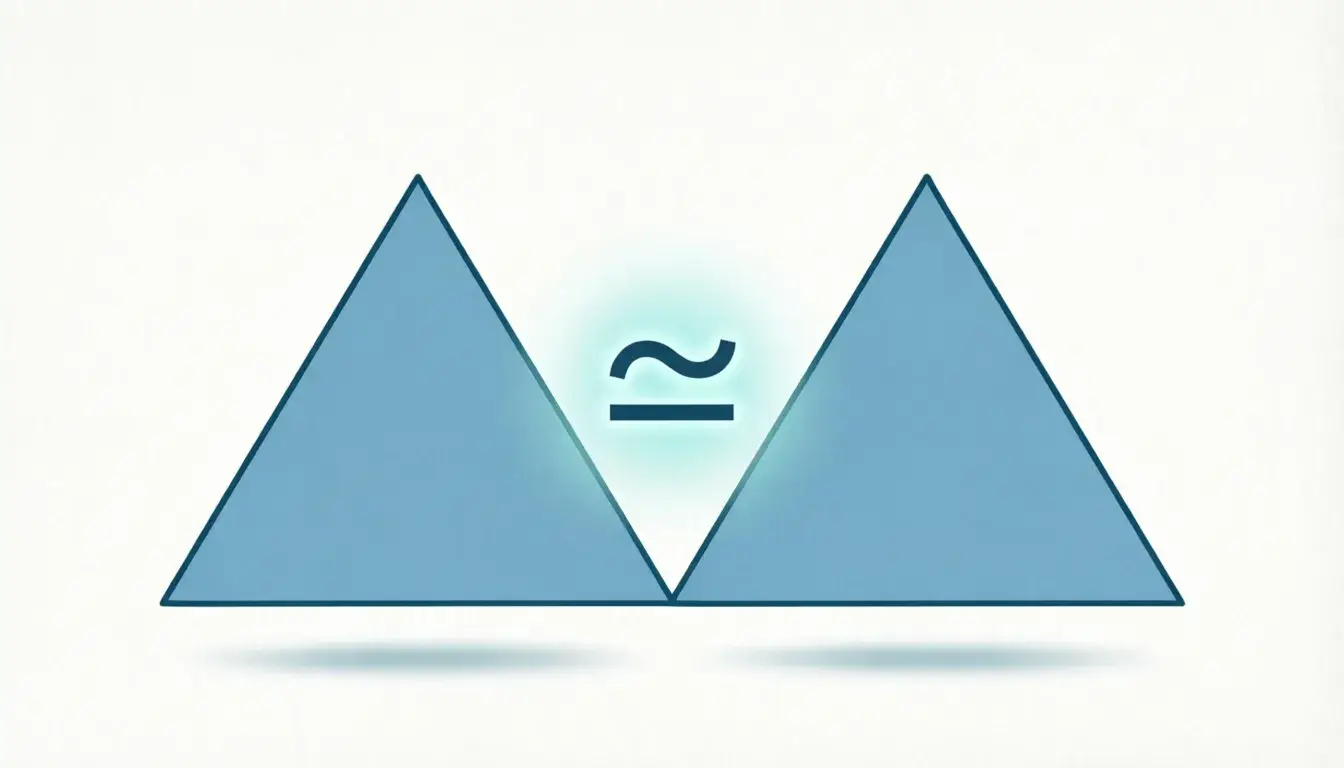
Let’s start with the basics. Congruent means exactly equal in size and shape. Two things are congruent when they match perfectly. Think of it like stacking two identical coins on top of each other. They line up completely. That’s congruence.
The word comes from the Latin congruere, meaning “to agree” or “to meet together.” In math, it means two figures agree — they’re identical copies of each other.
Congruent vs. Equal — What’s the Difference?
These two words sound similar but mean different things in math:
| Term | Used For | Example |
|---|---|---|
| Equal (=) | Numbers and values | 5 = 5 |
| Congruent (≅) | Shapes, figures, angles | Triangle ABC ≅ Triangle DEF |
Use equal for numbers. Use congruent for geometric figures. Simple.
The Congruence Symbol
The symbol for congruent is ≅. It looks like an equals sign with a tilde (~) on top. When you write “Segment AB ≅ Segment CD,” you’re saying both segments are the same length.
What Does Congruent Mean in Math?
In math, congruent means two figures have the same measurements. Same size. Same shape. Nothing more, nothing less.
Here’s what’s key: position doesn’t matter. You can flip, rotate, or slide a shape. If it still matches the other shape perfectly, they’re congruent. Mathematicians call these movements rigid transformations.
The Three Rigid Transformations
- Translation — sliding the shape without turning it
- Rotation — spinning the shape around a point
- Reflection — flipping the shape over a line
If you can get from one figure to another using any combination of these, the two figures are congruent. That’s the math definition in action.
Why Does This Matter?
Understanding what congruent means in math terms helps you solve real problems. Architects use congruence when designing symmetric buildings. Engineers use it when making identical parts. Even video game designers use it to duplicate objects precisely.
What Does Congruent Mean in Geometry?
Geometry is where congruence really shines. In geometry, what does congruent mean? It means two shapes have the same size and shape, and can be mapped onto each other through rigid transformations.
This applies to:
- Line segments — congruent if they have equal length
- Angles — congruent if they have equal degree measurements
- Polygons — congruent if all corresponding sides and angles are equal
- Circles — congruent if they have the same radius
Congruence Statements in Geometry
When you write a congruence statement, order matters. If Triangle ABC ≅ Triangle DEF, then:
- Angle A corresponds to Angle D
- Angle B corresponds to Angle E
- Angle C corresponds to Angle F
- Side AB corresponds to Side DE
Getting the order wrong changes the meaning entirely. Always match up corresponding parts carefully.
Congruence vs. Similarity
Here’s a common mix-up students make:
| Property | Congruent | Similar |
|---|---|---|
| Same shape | ✓ Yes | ✓ Yes |
| Same size | ✓ Yes | ✗ No |
| Scale factor | 1:1 | Any ratio |
| Symbol | ≅ | ~ |
Similar shapes look alike but differ in size. Congruent shapes are identical. Think of a photo and a blown-up poster of the same image — similar. Two printed copies at the same size — congruent.
What Does Congruent Mean in Geometry Angles?
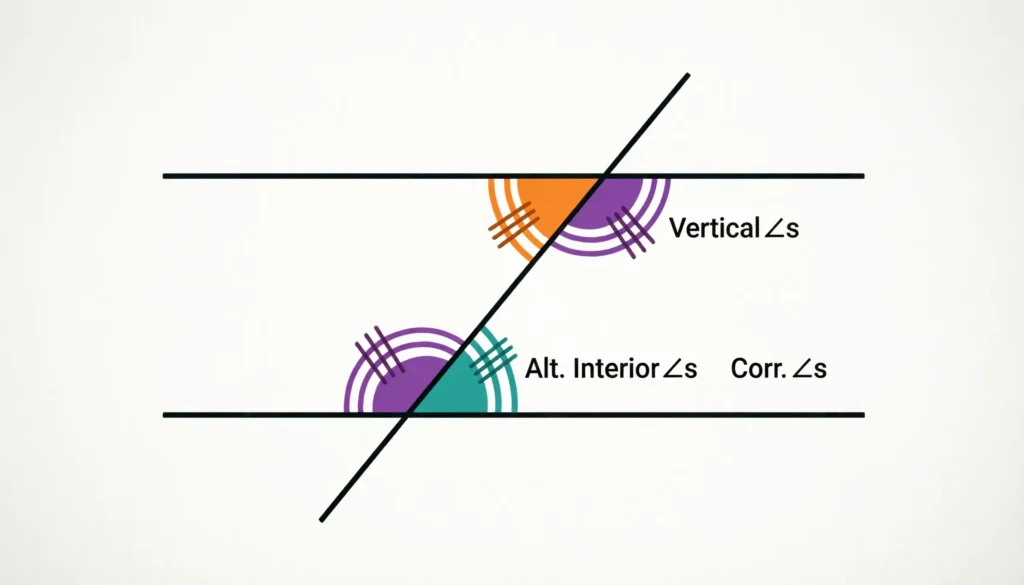
Angles are congruent when they have the same degree measure. That’s it. The direction they face doesn’t matter. The length of their rays doesn’t matter. Only the measurement counts.
Types of Congruent Angles You’ll See
Vertical angles — When two lines cross, the opposite angles formed are always congruent. Always. This is a theorem in geometry, not just a coincidence.
Corresponding angles — When a line crosses two parallel lines, the matching corner angles are congruent.
Alternate interior angles — Also formed by a line crossing two parallel lines. These angles sit between the parallel lines and are on opposite sides of the transversal. They’re congruent.
Alternate exterior angles — Same setup as above, but outside the parallel lines. Also congruent.
Real-World Angle Congruence
Look at a set of railroad tracks. The rails are parallel lines. Any crossing road acts as a transversal. The angles formed at each rail are congruent. Engineers count on this to keep tracks safe and consistent.
What Does Congruent Mean in Shapes?
When two shapes are congruent, every part matches up. Every side and every angle. Every vertex. The shapes are perfect twins.
How to Check if Two Shapes Are Congruent
Use this checklist:
- Count the sides — same number?
- Measure the sides — same lengths?
- Measure the angles — same degrees?
- Can you flip, rotate, or slide one to match the other?
If all answers are yes, the shapes are congruent.
Everyday Congruent Shapes
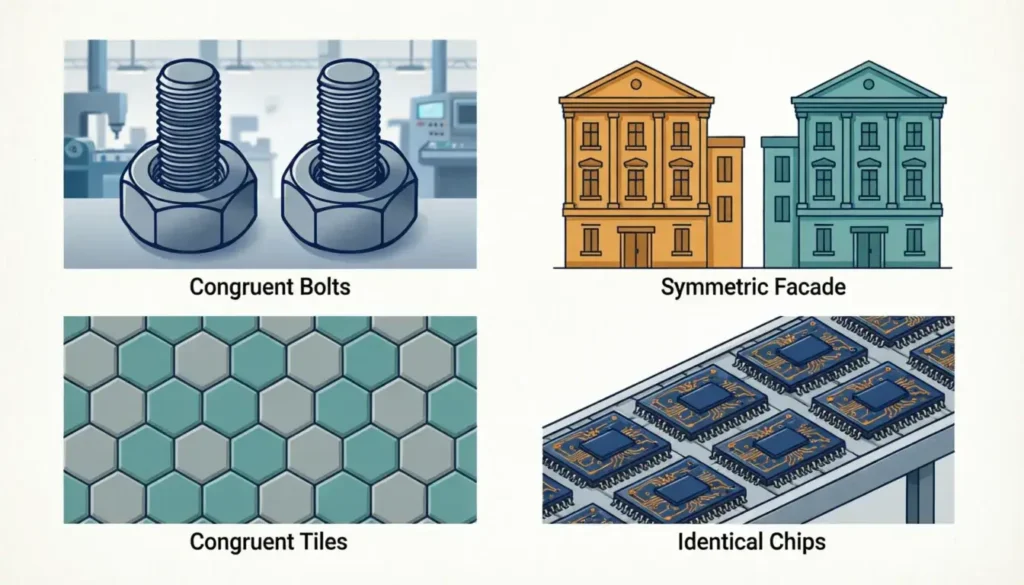
You see congruent shapes every day. Floor tiles are congruent — they’re identical copies laid side by side. The keys on a keyboard are (mostly) congruent rectangles. Bricks in a wall. Fence posts. Buttons on a shirt. Congruence is everywhere.
Understanding this concept also helps when you’re reading about everyday language. Just like how people search for things like what does NP mean or what does rizz mean when learning new terms, congruent is a word worth adding to your vocabulary.
What Does Congruent Mean in Triangles?
Triangles are where congruence gets the most attention in school. Why? Because there are special rules — called congruence theorems — that let you prove triangles are congruent without measuring every single part.
The 5 Triangle Congruence Theorems
| Theorem | What You Need to Know |
|---|---|
| SSS (Side-Side-Side) | All three sides are equal |
| SAS (Side-Angle-Side) | Two sides and the included angle are equal |
| ASA (Angle-Side-Angle) | Two angles and the included side are equal |
| AAS (Angle-Angle-Side) | Two angles and a non-included side are equal |
| HL (Hypotenuse-Leg) | Only for right triangles — hypotenuse and one leg are equal |
When These Theorems Are Used
These aren’t just abstract rules. Surveyors use triangle congruence to measure land. Builders use it to ensure roof trusses are identical. Navigation systems use it in triangulation to find positions.
A Common Mistake
Students sometimes think AAA (Angle-Angle-Angle) proves congruence. It doesn’t. Two triangles can have the same three angles but be different sizes. That makes them similar, not congruent. Always check side measurements too.
What Does Congruent Mean for Kids? A Simple Explanation
If you’re explaining this to a younger learner, keep it concrete. What does congruent mean for kids? Think of it this way:
“Two shapes are congruent if you could cut one out and it would fit perfectly on top of the other — like puzzle pieces that are exactly the same.”
Fun Ways to Teach Congruence
- Stencils: Trace the same stencil twice. Both tracings are congruent.
- Stamps: Stamp the same ink stamp twice. Congruent!
- Cookie cutters: Cut two cookies with the same cutter. Congruent cookies.
- Photocopies: Two copies of the same page at 100%. Congruent documents.
Kids get it fast when you connect it to real life. Abstract definitions come second. Hands-on understanding comes first. Just like learning slang terms such as what does JFC mean or what does WTW mean — context makes everything click.
Congruence in the Real World: Why It Matters
Congruence isn’t just a school topic. It’s a fundamental idea that powers real industries.
Manufacturing: Car parts must be congruent. A bolt made in one factory must match a nut made in another. If they’re not congruent, the car doesn’t work.
Architecture: Symmetric buildings use congruent shapes. The left side mirrors the right side perfectly.
Art and design: Patterns use congruent shapes to create repeating, balanced designs. Wallpaper. Fabric. Tiles.
Technology: Circuit boards are produced in congruent copies. Each chip must be identical.
Medicine: Surgical tools are manufactured to exact, congruent specifications. Lives depend on it.
Understanding what congruent means in math isn’t just academic. It connects to almost every technical field. And knowing terms like what does OFC mean or what does FYM mean helps you communicate clearly in casual life — just as knowing math vocabulary helps you communicate precisely in technical fields.
CPCTC — Congruent Parts of Congruent Triangles
Once you’ve proven two triangles are congruent, you unlock a powerful tool: CPCTC. It stands for Corresponding Parts of Congruent Triangles are Congruent.
This means once you know two triangles are congruent, you automatically know every single pair of corresponding parts is also congruent.
How CPCTC Works in Proofs
- Prove two triangles are congruent (using SSS, SAS, ASA, AAS, or HL)
- Identify the part you need to prove congruent
- State: “By CPCTC, the parts are congruent”
It’s a shortcut. A powerful one. Geometry teachers love it. Students who understand it ace their proofs.
Frequently Asked Questions
What does congruent mean in simple terms?
Congruent means two shapes or figures are exactly the same — same size, same shape. If you placed one on top of the other, they’d match up perfectly. It’s used in math and geometry to describe shapes that are identical copies of each other, even if they face different directions.
What does congruent mean in math angles?
Two angles are congruent in math when they have the exact same degree measurement. For example, a 45° angle is congruent to any other 45° angle. The size of the rays doesn’t matter. Only the measurement of the opening between them counts. The symbol used is ≅.
What does congruent mean in geometry for triangles?
In geometry, two triangles are congruent when all three sides and all three angles are equal. You don’t always need to check all six measurements. The congruence theorems (SSS, SAS, ASA, AAS, HL) let you prove triangle congruence with fewer measurements.
What does congruent mean in maths vs. similar?
Congruent shapes are identical — same size and shape. Similar shapes have the same shape but different sizes. Think of a photo and a blown-up version: similar. Two prints at the same size: congruent. Congruent uses the ≅ symbol; similar uses ~.
Is congruent the same as equal in math?
Not exactly. Equal (=) refers to numbers and values. Congruent (≅) refers to geometric figures like shapes, segments, and angles. When a segment is 5 cm long and another is also 5 cm, their lengths are equal, but the segments are congruent. Same idea, slightly different language. Just like what does SMD mean differs from what does KMS mean — similar vibes, different meanings.
What does congruent mean in shapes like squares and rectangles?
Two squares are congruent if they have the same side length. Two rectangles are congruent if both their length and width match. All corresponding sides and angles must be equal. For any polygon, check every side and every angle. If everything matches, the shapes are congruent. Also note: what does GMFU mean is another common term worth knowing when you’re building vocabulary.
Conclusion: What You Now Know About Congruent
Let’s recap. What does congruent mean? It means two figures are exactly the same — identical in size and shape. Here are the key takeaways:
- Congruent applies to shapes, angles, and segments — not just numbers
- The symbol is ≅, not =
- Position doesn’t matter — flipping, rotating, or sliding doesn’t change congruence
- In triangles, use SSS, SAS, ASA, AAS, or HL to prove congruence
- In angles, equal degree measurements = congruent angles
- CPCTC unlocks all corresponding parts once triangles are proven congruent
You came in confused. Now you have the full picture. Take this knowledge into your next geometry class. Use it when solving proofs. Look for congruence in the world around you — tiles, tracks, and tools. Math makes more sense when you see it in action. You’ve got this.