What Does Ion Mean? The Complete Guide to Understanding Ion in Texts and Science
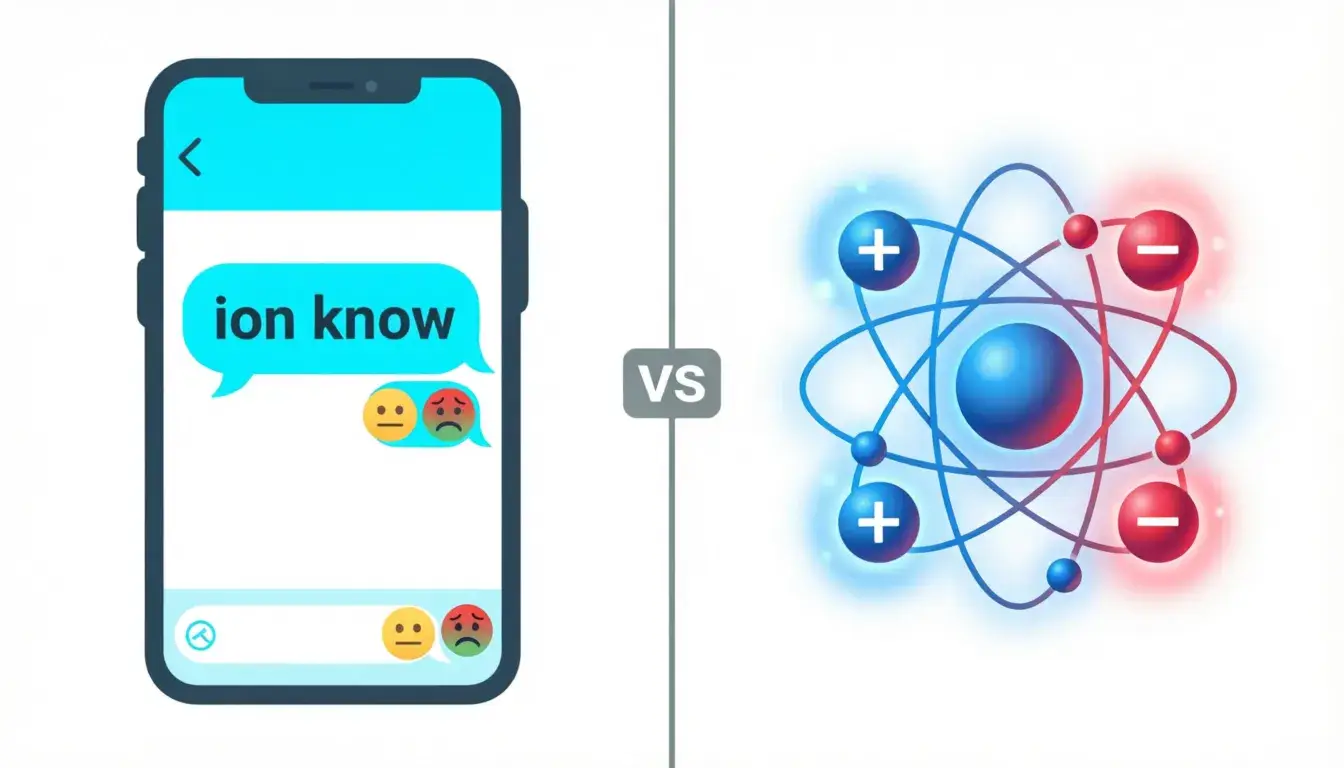
What does ion mean when you see it pop up in texts? You’re not alone in wondering. Millions of people get confused when they encounter this three-letter word. It has two completely different meanings. One comes from chemistry class. The other belongs to modern texting culture. This guide breaks down both meanings clearly. You’ll learn when to use each one. Plus, you’ll avoid embarrassing mix-ups in your conversations.
Understanding what does ion mean matters more than you think. Misreading it can change entire conversations. The context tells you everything. Is your friend discussing science homework? They probably mean the chemistry term. Did someone text “ion know” casually? That’s slang for “I don’t.” We’ll explore both meanings in depth. You’ll become fluent in ion language fast.
Ion in Texting: The Slang Meaning Everyone Uses
What Does Ion Mean in Text Messages?
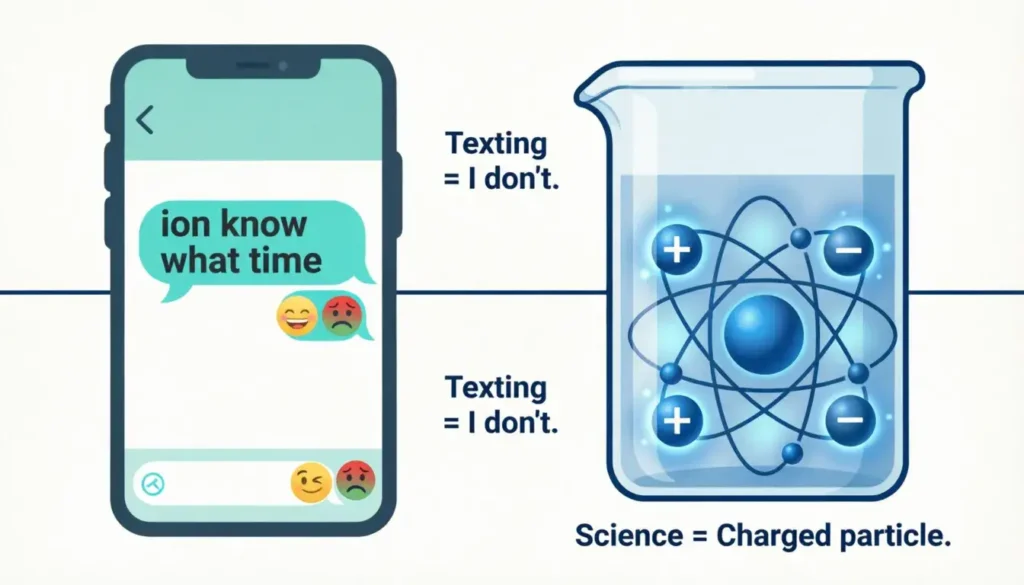
What does ion mean in text conversations? It’s simple shorthand. Ion = “I don’t” in texting slang. People use it to save time. It makes messages quicker to type. Think of it as textspeak efficiency.
Here’s how it works in real conversations:
- “Ion know where she went”
- “Ion care about that drama”
- “Ion think he’s coming today”
The phrase eliminates two keystrokes. It flows naturally in casual chat. Most Gen Z users type it without thinking. It’s become automatic in their messaging style.
Where Did This Slang Come From?
The texting version emerged from AAVE (African American Vernacular English). It mimics how people actually speak. When you say “I don’t” quickly, it sounds like “ion.” The spelling matches the pronunciation perfectly.
Social media platforms accelerated its spread. TikTok, Instagram, and Snapchat users adopted it fast. Now it crosses all demographic boundaries. You’ll see it in group chats everywhere. Similar slang terms like what does np mean and what does ofc mean follow the same pattern.
Common Contexts for Ion in Texting
What does ion mean on Snapchat and other platforms? The usage stays consistent. People use it in casual, informal conversations. It never appears in professional emails. You won’t find it in formal writing.
Here are the most common scenarios:
| Context | Example | Meaning |
|---|---|---|
| Uncertainty | “Ion really know tbh” | I don’t really know to be honest |
| Disinterest | “Ion care anymore” | I don’t care anymore |
| Denial | “Ion think that’s right” | I don’t think that’s right |
| Inability | “Ion have time for this” | I don’t have time for this |
The tone matters significantly. Ion sounds more casual than “I don’t.” It adds personality to messages. Think of it like what does rizz mean – pure modern slang.
What Does Ion Mean From a Girl?
What does ion mean in text from a girl? Exactly the same thing. Gender doesn’t change the definition. Girls and guys use it identically. The meaning stays “I don’t” regardless.
However, tone can vary by person. Some use it playfully. Others type it when frustrated. Pay attention to surrounding context. The conversation flow reveals emotional undertones.
Watch for these patterns:
- Multiple ions in quick succession = emphasis or frustration
- Ion with emojis = lighter, more playful tone
- Ion alone = straightforward, neutral statement
Ion in Chemistry: The Scientific Explanation
What Does Ion Mean in Chemistry?
What does ion mean in chemistry? It’s a charged particle. Atoms normally have neutral charges. They contain equal protons and electrons. When an atom gains or loses electrons, it becomes an ion.
Two main types exist:
- Cations: Positively charged ions (lost electrons)
- Anions: Negatively charged ions (gained electrons)
Think sodium chloride (table salt). Sodium loses one electron, becoming Na+. Chlorine gains one electron, becoming Cl-. These opposite charges attract each other. That creates the ionic bond.
How Ions Form and Function
Ions power countless chemical reactions. They exist everywhere in nature. Your body depends on them constantly. Salt water contains dissolved ions. Batteries use ion movement for electricity.
The formation process follows simple rules:
- Atoms seek stability through full electron shells
- Some atoms give away electrons easily
- Others grab electrons readily
- This exchange creates charged particles
- Opposite charges attract and bond
Your muscles contract using calcium ions. Nerve signals travel via sodium and potassium ions. Without ions, human biology wouldn’t function. Pretty important stuff, right?
Everyday Examples of Ions
You encounter ions constantly. Here’s where they show up daily:
Common Ion Sources:
- Salt (sodium and chloride ions)
- Baking soda (sodium and bicarbonate ions)
- Sports drinks (electrolyte ions)
- Car batteries (lead and sulfate ions)
- Ocean water (various mineral ions)
Even the air around you contains ions. Lightning creates them during storms. Some air purifiers generate negative ions. The science is everywhere once you notice it.
How to Tell Which Meaning Someone Means
Context Clues That Reveal the Correct Meaning
Figuring out which “ion” someone means seems tricky. Actually, it’s pretty straightforward. Context makes everything clear. Look at the conversation type first.
Quick Decision Framework:
| Signal | Meaning |
|---|---|
| Casual text message | Probably slang (“I don’t”) |
| Science class discussion | Definitely chemistry term |
| Social media post | Likely slang |
| Academic paper | Chemistry term |
| Uses “ion” as standalone word | Chemistry |
| Uses “ion” before verb | Slang |
Text patterns reveal meaning instantly. “Ion know” clearly means “I don’t know.” “Ion concentration” obviously refers to chemistry. The words surrounding “ion” give you the answer.
Platform-Specific Usage Patterns
What does ion mean on Instagram versus other platforms? The slang version dominates social media. Instagram, TikTok, Twitter, and Snapchat lean heavily toward “I don’t.” Scientific discussions rarely happen there.
Professional platforms differ completely. LinkedIn posts about ions mean chemistry. Academic forums discuss particle charges. The platform sets expectations immediately.
Here’s the breakdown:
Slang Territory:
- Text messages between friends
- Instagram DMs and comments
- TikTok captions and comments
- Snapchat conversations
- Twitter casual threads
Chemistry Territory:
- Educational websites
- Scientific journals
- Chemistry homework help forums
- Professional research discussions
Understanding platform norms helps tremendously. You’ll rarely second-guess meanings. The context screams the answer at you. Similar to understanding terms like what does jfc mean or what does smd mean, context is king.
Regional and Generational Differences
Age Groups and Ion Usage
Younger generations dominate slang ion usage. Gen Z types it constantly. Millennials recognize and sometimes use it. Older generations often feel confused.
Age-based patterns emerge clearly:
- Gen Z (born 1997-2012): Uses ion slang naturally and frequently
- Millennials (born 1981-1996): Understands it, uses it occasionally
- Gen X and older: Often unfamiliar with slang usage
The chemistry meaning crosses all ages. Everyone learned about ions in school. Scientific literacy doesn’t discriminate by generation.
Geographic Variations
The slang version started in American urban communities. It spread through hip-hop culture and AAVE. Now it appears globally through internet culture.
Regional differences exist but fade online. Digital communication erases geographic boundaries. A teenager in Tokyo might use “ion” like someone in New York. The internet creates linguistic unity.
However, some regions embrace it faster:
- Urban areas adopted it first
- Coastal cities lead trends
- Rural areas lag slightly behind
- International users adapt through social media exposure
What Does Ion Mean on Different Devices and Platforms
Ion on Fans and Appliances
What does ion mean on a fan? That’s completely different territory. Here we’re back to chemistry. Ionic technology in fans refers to air purification. These devices generate negative ions. The ions attach to airborne particles. This makes dust and allergens fall from the air.
Fan manufacturers use “ion” as a marketing term. It suggests cleaner, fresher air. The technology does work to some degree. Scientific evidence supports mild benefits. Don’t expect miracles though.
The same technology appears in:
- Air purifiers
- Hair dryers (reduces frizz)
- Humidifiers
- Air conditioners
- Car air fresheners
Digital Platforms and Texting Apps
What does ion mean on text across different apps? The slang meaning dominates everywhere. iMessage, WhatsApp, Telegram, and Signal users all understand it. The abbreviation works universally.
Platform-specific features don’t change meanings. Snapchat’s temporary messages use ion identically. Instagram’s character limits make abbreviations useful. The definition stays consistent everywhere.
Cross-platform consistency helps tremendously. You don’t need separate dictionaries per app. Learn it once, use it anywhere. This differs from platform-specific slang like certain TikTok terms.
Comparing Ion to Similar Text Abbreviations
How Ion Compares to Other Slang Terms
Ion fits into the broader texting ecosystem. Many abbreviations serve similar purposes. Understanding the family helps. You’ll communicate better overall.
Related Abbreviations:
| Term | Meaning | Usage Level |
|---|---|---|
| Ion | I don’t | Very common |
| Idk | I don’t know | Extremely common |
| Idc | I don’t care | Very common |
| Imo | In my opinion | Common |
| Tbh | To be honest | Very common |
Each serves specific communication needs. Ion provides contraction efficiency. Idk adds the “know” explicitly. Idc specifies the caring aspect. They complement each other perfectly.
Terms like what does wtw mean and what does fym mean operate similarly. They streamline common phrases into quick abbreviations.
When to Use Ion vs Full Words
Choose wisely between “ion” and “I don’t.” Consider your audience carefully. Match the formality level appropriately.
Use “ion” when:
- Texting close friends
- Posting casually on social media
- Speed matters in conversation
- The tone is relaxed and informal
- Everyone understands modern slang
Use “I don’t” when:
- Writing professionally
- Texting parents or teachers
- Applying for jobs
- Creating formal content
- Audience might not understand slang
Misjudging formality creates awkward situations. Nobody wants to text their boss “ion know.” Save slang for appropriate contexts. Professional settings demand standard English.
Common Mistakes and Misconceptions
Spelling Variations and Errors
People frequently misspell ion in texts. Common mistakes include “iont,” “iono,” and “ionn.” These variations sometimes appear intentionally. They add emphasis or regional flavor.
Accepted variations:
- Ion: Standard spelling
- Iont: Emphasizes “I don’t” more forcefully
- Iono: Short for “I don’t know” specifically
- Ionno: Alternative “I don’t know” spelling
Autocorrect battles create hilarious moments. Your phone might change “ion” to “ion” (the chemistry term). This causes confusion in casual conversations. Disable autocorrect for slang terms if needed.
Confusing the Two Meanings
The biggest mistake? Mixing up contexts completely. Someone asks about chemistry homework. You respond with slang ion usage. Embarrassment follows quickly.
Real examples of confusion:
- “The ion concentration is important” → Don’t reply “ion care”
- “These ions carry charges” → This isn’t about not doing something
- “Ion think so” → Not a scientific statement about particles
Stay alert to conversation topics. Scientific discussions need scientific vocabulary. Casual chats welcome slang freely. The switch should feel natural. Terms like what does kms mean require similar contextual awareness.
The Evolution of Text Speak and Ion’s Place
How Texting Language Develops
Text abbreviations follow predictable patterns. They emerge from spoken language. People type how they talk. Efficiency drives adoption rates.
Ion represents this evolution perfectly. It captures actual pronunciation and it saves typing effort. It sounds natural when read aloud. These factors guarantee survival and spread.
The lifecycle goes like this:
- Phrase exists in spoken language
- Early adopters text it phonetically
- Social media amplifies usage
- Mainstream users adopt it
- Eventually becomes standard textspeak
Ion’s Future in Digital Communication
Will ion stick around long-term? Probably yes for several reasons. It serves genuine communication needs. The pronunciation mapping makes sense. Young users have fully embraced it.
Language constantly evolves though. New abbreviations emerge regularly. Ion might eventually seem outdated. Today’s slang becomes tomorrow’s cringe. That’s how generational language works.
Current trends suggest staying power:
- Usage continues growing steadily
- Appears in mainstream media increasingly
- Dictionaries might eventually include it
- Cross-platform adoption remains strong
Similar terms like what does gmfu mean show how slang becomes permanent. Digital communication creates lasting linguistic changes.
Frequently Asked Questions
What does ion mean in texting?
Ion means “I don’t” in text messages. It’s slang that mimics how people pronounce “I don’t” quickly in speech. You’ll see it in casual conversations like “ion know” (I don’t know) or “ion care” (I don’t care). It saves time and adds informal tone to messages.
What does ion mean in chemistry class?
In chemistry, an ion is an atom with an electric charge. It forms when atoms gain or lose electrons. Positive ions (cations) lost electrons. Negative ions (anions) gained electrons. They’re essential for chemical reactions and everyday processes like muscle contractions.
What does ion mean on Snapchat?
On Snapchat, ion means “I don’t” just like other platforms. The slang usage stays consistent across all social media. People use it for quick, casual responses. It fits Snapchat’s informal, fast-paced communication style perfectly.
Can ion mean both things in one conversation?
Technically yes, but it rarely happens. Chemistry discussions stay scientific. Casual texts use slang exclusively. The context makes the meaning obvious. You won’t genuinely confuse them in practice because surrounding words clearly indicate which meaning applies.
Is using ion in texts considered proper English?
No, ion is informal slang. Avoid it in professional emails, school papers, or formal writing. Save it for texts with friends, social media posts, and casual conversations. Formal contexts require standard English like “I don’t” spelled completely.
What does ion mean when someone types “ion even know”?
This phrase means “I don’t even know.” It expresses uncertainty or confusion about something. The “even” adds emphasis to the lack of knowledge. It’s extremely common in casual texting among younger users.
Conclusion
What does ion mean depends entirely on context. In texting, it’s shorthand for “I don’t.” In chemistry, it’s a charged particle. Both meanings matter in different situations. Understanding context prevents confusion completely.
You now know when to use which meaning. Casual conversations welcome the slang version freely. Scientific discussions require the chemistry definition. Match your language to your audience always.
The key takeaways are simple. Look at who’s talking and where. Check the surrounding words carefully. Notice whether the conversation feels formal or casual. These signals reveal everything instantly.
Start practicing your ion fluency today. Pay attention in your next text conversation. Notice how friends use it naturally. Soon you’ll type it without thinking twice. Language evolution happens through usage and understanding.