What Does OFC Mean? Complete Guide to This Popular Text Slang
What does ofc mean in text messages? You’ve probably seen it pop up in your chats. Maybe a friend used it. Maybe you saw it on TikTok or Instagram. And now you’re wondering what it actually means.
Here’s the thing: text slang changes fast. New acronyms appear daily. Some stick around. Others fade away. But OFC has become a staple in digital communication.
Don’t worry if you’re confused. You’re not alone. Thousands of people search for this term every single day. They want to understand it and they want to use it correctly. They don’t want to look out of touch.
This guide will clear everything up. You’ll learn exactly what OFC means and you’ll discover when to use it. You’ll see real examples from everyday conversations. Plus, you’ll avoid common mistakes that make you look like you don’t get it.
By the end, you’ll be using OFC like a pro. Let’s dive in.
What Does OFC Mean in Texting?
OFC stands for “of course.” Simple as that.
It’s one of the most popular acronyms in digital communication. People use it constantly in text messages, social media posts, and online chats. It’s quick. It’s easy. It gets the point across.
Think of it as a shortcut. Instead of typing “of course,” you just type three letters. It saves time. It keeps conversations moving fast. That’s exactly why it caught on.
The meaning stays consistent across platforms. Whether you’re on Snapchat, Instagram, TikTok, or texting, OFC always means “of course.” No hidden meanings. No confusion.
Here’s what makes it useful:
- Speed: Three letters beat nine characters every time
- Casual tone: It sounds friendly and relaxed
- Universal understanding: Most people know what it means
- Versatility: Works in almost any casual conversation
Origins of OFC
Text slang exploded with the rise of SMS messaging. Character limits forced people to get creative. They shortened everything. “You” became “u.” “Are” became “r.” And “of course” became OFC.
The acronym gained traction in the early 2000s. Online chat rooms used it heavily. Forums adopted it. Social media amplified it. Now it’s everywhere.
Younger generations embraced it quickly. Gen Z and millennials use it naturally. It’s part of their digital vocabulary. They don’t think twice about it.
What Does OFC Mean in Text Message Conversations?
In text messages, OFC serves multiple purposes. It’s not just about agreeing. It’s about how you agree.
Let’s break down the most common uses:
Agreement and Confirmation
When someone asks you a question, OFC confirms your answer. It’s like saying “absolutely” or “definitely.”
Example conversation:
- Person A: “Want to grab coffee tomorrow?”
- Person B: “OFC! What time?”
See how natural that feels? It’s enthusiastic. It’s positive. It moves the conversation forward.
Responding to Obvious Questions
Sometimes people ask questions with obvious answers. OFC lets you confirm while acknowledging the obviousness. It’s playful, not rude.
Example:
- Person A: “Did you watch the new episode?”
- Person B: “OFC I did! It was amazing!”
This shows excitement while confirming. It works perfectly in these situations.
Adding Emphasis
OFC adds weight to your statement. It emphasizes certainty. It removes any doubt about your position.
Example:
- “I’m coming to your party, ofc!”
- “OFC I support you. Always have, always will.”
The emphasis makes your commitment clear. There’s no room for misinterpretation.
What Does OFC Mean From a Girl?
This question comes up a lot. People wonder if OFC means something different when girls use it.
The answer? Not really.
Girls use OFC the same way everyone else does. It means “of course.” The context matters more than the gender of the sender.
However, tone can vary based on punctuation and context:
Enthusiastic and positive:
- “OFC I’ll be there! 😊”
- “OFC! Can’t wait!”
Neutral agreement:
- “ofc”
- “Ofc, sounds good”
Potentially sarcastic:
- “Ofc you forgot.”
- “OFC that happened.”
Notice the difference? Punctuation changes everything. Exclamation marks show enthusiasm. Periods can indicate sarcasm or annoyance. Context is king here.
Similar to how IKR can be enthusiastic or sarcastic, OFC’s meaning shifts with tone.
What Does OFC Mean on Different Platforms?
What Does OFC Mean on TikTok?
On TikTok, OFC appears in comments constantly. Users reply to videos with it. They confirm statements. They agree with creators.
Common TikTok usage:
- “OFC this is relatable!”
- “OFC I’m trying this trend”
- “OFC you’re right about this”
TikTok culture values quick responses. OFC fits perfectly. It’s fast. It’s casual. It matches the platform’s energy.
Creators also use it in video captions. They respond to comments with it. It builds connection with followers.
What Does OFC Mean on Snapchat?
Snapchat thrives on quick, casual communication. OFC is ideal for this environment.
People use it in snap replies. They use it in chat messages. They even use it in Stories text overlays.
Snapchat examples:
- Quick reply to plans: “OFC 👍”
- Response to streaks: “ofc keeping it going”
- Story polls: “OFC I’m team pizza”
The platform’s temporary nature encourages informal language. OFC fits this vibe perfectly.
What Does OFC Mean on Instagram?
Instagram users deploy OFC in comments, DMs, and Stories. It appears across all features.
Instagram contexts:
- Comment replies: “OFC this photo is stunning”
- DM conversations: Same as regular texting
- Story responses: Quick agreements or confirmations
Instagram’s diverse user base means OFC reaches multiple age groups. Younger users employ it more frequently. Older users might use it less often.
Just like MBN and other acronyms, OFC has become standard Instagram vocabulary.
When to Use OFC (And When Not To)
Perfect Times to Use OFC
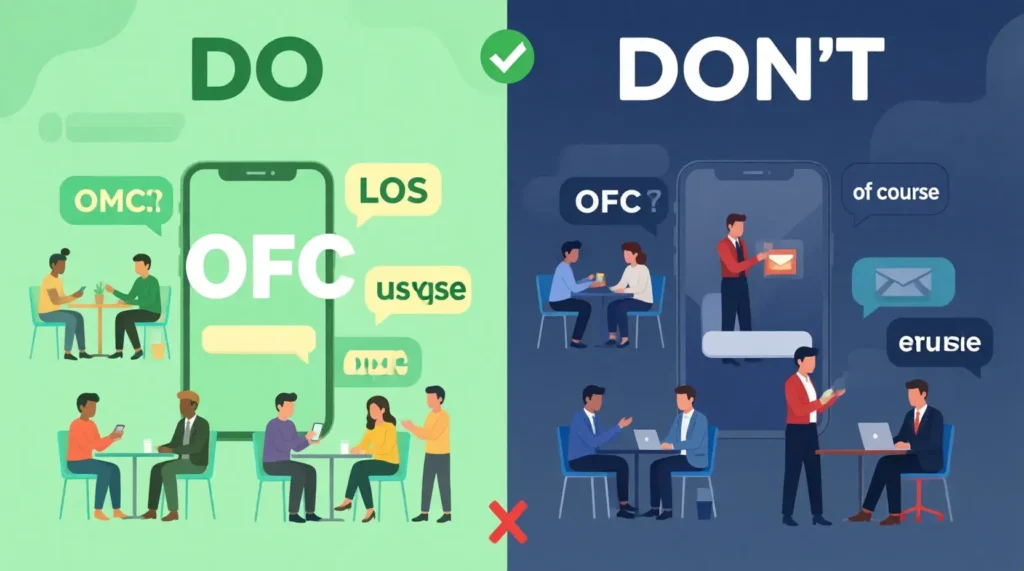
Casual conversations with friends:
Your friend group gets your communication style. OFC fits right in. Use it freely.
Social media interactions:
Comments, replies, and messages all work. Keep it casual and friendly.
Quick confirmations:
Someone asks a simple question. OFC gives a fast, clear answer.
Expressing enthusiasm:
You’re excited about plans. OFC shows your eagerness.
When to Avoid OFC
Professional communications:
Work emails, client messages, and formal contexts require proper language. Type out “of course” instead.
Talking to people who don’t know slang:
Older relatives or professional contacts might not understand. Use standard English.
Serious or sensitive conversations:
Heavy topics deserve full words. Don’t abbreviate when emotions run high.
First impressions:
Meeting someone new? Use complete sentences. Build rapport first. Add slang later.
| Use OFC | Avoid OFC |
|---|---|
| Friend group chats | Work emails |
| Social media comments | Job applications |
| Casual planning | Professional networking |
| Quick confirmations | Formal invitations |
| Enthusiastic responses | Serious discussions |
OFC vs. Similar Acronyms
Understanding the differences helps you communicate better. Let’s compare OFC to related terms.
OFC vs. OC
OFC = Of course
OC = Original content or original character
These mean completely different things. Context usually makes it clear. On creative platforms, OC typically means original content.
OFC vs. OMG
OFC = Of course (confirmation)
OMG = Oh my God (surprise/shock)
Different emotional responses. OFC agrees. OMG reacts.
OFC vs. OFCOURSE
Some people write “OFCOURSE” as one word. It’s the same as OFC. Just longer and less common.
Comparison Table
| Acronym | Meaning | Usage | Tone |
|---|---|---|---|
| OFC | Of course | Agreement, confirmation | Positive, casual |
| OMG | Oh my God | Surprise, shock | Excited, dramatic |
| IKR | I know, right | Agreement with emphasis | Enthusiastic, relatable |
| NP | No problem | Casual response | Friendly, helpful |
| IMK | In my knowledge | Stating awareness | Informative, uncertain |
Common Mistakes When Using OFC
Overusing It
Don’t use OFC in every response. It loses impact. Mix up your language. Keep things fresh.
Bad:
- “OFC”
- “OFC”
- “OFC”
Better:
- “OFC!”
- “Definitely!”
- “For sure”
Using It Sarcastically Without Clarity
Sarcasm doesn’t translate well in text. If you’re being sarcastic, make it obvious. Add context clues.
Unclear:
- “OFC you’re right” (Are you actually agreeing?)
Clear:
- “OFC you’re right 🙄” (Emoji shows sarcasm)
Forgetting Your Audience
Not everyone knows text slang. Consider who you’re talking to. Adjust accordingly.
Similar to how GMFU might confuse some people, OFC can too.
How to Respond When Someone Uses OFC
Match Their Energy
If they’re enthusiastic, be enthusiastic back. If they’re casual, stay casual.
Their message: “OFC I’m down for that!”
Your response: “Awesome! Let’s do it!”
Continue the Conversation
Don’t just acknowledge their OFC. Keep things moving.
Their message: “OFC I remember”
Your response: “Great! So about what we discussed…”
Don’t Overthink It
OFC is simple agreement. Accept it and move on. No need to analyze.
Text Slang Culture and OFC’s Place
Text slang evolves constantly. New terms emerge. Old ones fade. OFC has staying power.
Why? Because it’s useful. It serves a clear purpose. It saves time without causing confusion.
The internet creates its own language. Acronyms like WTM, LWK, and WYLL all fill specific needs. They make digital communication faster and more expressive.
OFC joins this toolkit. It’s not going anywhere soon.
Generational Differences
Gen Z uses OFC fluently. Millennials do too. Gen X might recognize it. Boomers often don’t.
This creates communication gaps. But it’s normal. Every generation has its slang.
The key? Be adaptable. Know your audience. Switch between formal and informal as needed.
Real-World Examples of OFC in Use
Example 1: Making Plans
Conversation:
- Alex: “Movie night Friday?”
- Jordan: “OFC! What time?”
- Alex: “7pm work?”
- Jordan: “Perfect”
Clean. Simple. Effective.
Example 2: Confirming Attendance
Group chat:
- Sarah: “Everyone coming to dinner tomorrow?”
- Mike: “OFC”
- Lisa: “Wouldn’t miss it!”
- Tom: “Ofc I’ll be there”
Notice the capitalization variations? Both work fine.
Example 3: Social Media Comment
Instagram post about a concert:
Comment: “OFC this looks amazing! Wish I was there 😭”
Shows enthusiasm and agreement with the post’s vibe.
Example 4: Supportive Response
Text conversation:
- Friend: “Nervous about my presentation”
- You: “You’ll do great, ofc!”
- Friend: “Thanks 🙂”
Provides reassurance quickly and casually.
Similar to how TIL adds value in sharing knowledge, OFC adds warmth in showing support.
Variations and Related Terms
OBV
Means “obviously.” Similar to OFC but with stronger assumption.
Example: “OBV I’m going to the party”
OBVI
Another form of “obviously.” More playful than OBV.
Example: “Obvi I knew that already”
DEF
Short for “definitely.” Stronger certainty than OFC.
Example: “Def coming tonight”
FS
“For sure.” Very similar to OFC in meaning.
Example: “FS I’ll be there”
These all serve similar purposes. They confirm and they agree. They keep conversations flowing.
Like DTM, these acronyms speed up digital communication.
The Psychology Behind Using OFC
Why do people use acronyms like OFC? Several reasons drive this behavior.
Efficiency
Typing is work. Three letters beat nine characters. Simple math.
Social Belonging
Using current slang signals you’re “in the know.” You’re part of the digital culture. You understand the language.
Casualness
Full words can sound formal. Acronyms sound relaxed. They create a friendly tone.
Speed of Conversation
Digital chats move fast. Quick responses keep momentum. OFC maintains flow.
Emotional Expression
Sometimes “of course!” feels different from “OFC!” The acronym can soften or emphasize depending on context.
Teaching Others What OFC Means
Got family or friends who don’t know text slang? Here’s how to explain OFC simply.
1: Tell them it means “of course”
2: Show them an example in context
3: Explain when it’s appropriate
4: Let them ask questions
Example explanation:
“OFC is just a short way to say ‘of course’ in texts. Like if I ask you ‘Want pizza for dinner?’ and you text back ‘OFC,’ you’re saying yes. It’s casual and friendly.”
Keep it simple. Don’t overcomplicate it.
The Future of OFC and Text Slang
Will OFC stick around? Probably.
It’s simple and it’s useful. It’s widely understood. These factors suggest longevity.
Text slang that survives shares common traits:
- Saves significant time
- Easy to remember
- Clear meaning
- Fills a real need
- Widely adopted
OFC checks all boxes.
However, language evolves. New platforms bring new slang. OFC might eventually be replaced. For now, it’s here to stay.
Tips for Using OFC Effectively
Tip 1: Match Your Tone
Use exclamation marks for enthusiasm. Use periods for calm agreement. Adjust to your message.
Tip 2: Consider Context
Work chat? Skip it. Friend group? Use freely. Read the room.
Tip 3: Don’t Force It
If it feels unnatural, type out “of course.” Authenticity beats trying too hard.
Tip 4: Mix It Up
Vary your vocabulary. Use OFC sometimes. Use other responses other times. Keep it fresh.
Tip 5: Watch for Sarcasm
If you’re being sarcastic, make it crystal clear. Add emojis or context.
Frequently Asked Questions
What does OFC mean in text?
OFC means “of course” in text messages. It’s a quick way to agree with someone or confirm something. People use it to save time while texting. It’s casual and friendly. Most young people understand it immediately.
What does OFC mean from a girl in texting?
When a girl uses OFC, it means the same thing as when anyone uses it: “of course.” The meaning doesn’t change based on gender. However, tone can vary with punctuation. “OFC!” shows enthusiasm. “ofc.” might show sarcasm. Context matters most.
What does OFC mean on Snapchat?
On Snapchat, OFC still means “of course.” People use it in snap messages, chat replies, and story responses. It fits Snapchat’s casual, fast-paced communication style. It’s one of the most common acronyms on the platform.
Is OFC rude or sarcastic?
OFC isn’t inherently rude. But it can sound sarcastic depending on context. “OFC I remember” could be genuine or sarcastic. Punctuation helps clarify. Exclamation marks show positivity. Periods can indicate sarcasm. When in doubt, add emojis to show tone.
What does OFC mean on TikTok?
On TikTok, OFC means “of course.” Users comment it on videos to agree with creators. They use it to confirm relatable content. It appears in video captions too. TikTok’s fast culture makes OFC perfect for quick interactions.
Can I use OFC in professional emails?
No, avoid OFC in professional settings. Use “of course” instead. Full words sound more professional. Save acronyms for casual conversations with friends. Formal communication requires standard language. Know your audience and adjust accordingly.
Conclusion
You now know what does ofc mean in every context. It’s “of course” – simple and straightforward.
You’ve learned when to use it and when to avoid it. You understand how it works across different platforms. You’ve seen real examples in actual conversations.
Here are the key takeaways:
OFC means “of course” in all contexts. It saves time in casual digital communication. Use it with friends, on social media, and in relaxed settings. Avoid it in professional or formal situations.
Context changes tone. Punctuation matters. “OFC!” shows enthusiasm. “ofc.” might indicate sarcasm. Pay attention to how you present it.
Not everyone knows text slang. Consider your audience. Adjust your language accordingly. When in doubt, type it out fully.
Start using OFC confidently in your casual conversations. Practice makes perfect. You’ll get the hang of it quickly.
Now go text your friends. Try it out. See how natural it feels. OFC you’ve got this!